
Showing posts with label Committee Session. Show all posts
Committee Session II & III
Day 2 of the conference saw all the committees passing resolutions for thier first topic. Here's a summary of the committee sessions II & III:

Disarmament
and International Security Committee
The Disarmament and International Security
Committee (DISEC), was one of the first committees to pass their resolution.
The resolution attempted to resolve the issue of blood diamonds and reflects
the hard work involved in the creating and debating processes that transpired
behind the doors.
The impressive speed at which the DISEC
functioned at seemed to result from the large amount of personal interest that
each of the delegates showed in the topic. Despite the fact that many of them
were personally far removed from the issue, many delegates considered the topic
of blood diamonds to be a crucial issue and were therefore enthusiastic about
cooperating to come to a resolution that served to resolve the issue. The
delegate of the United States said, “blood diamonds have to be regulated in
order to create the equality and safety for those who are forced to work in the
mines and who live in fear.” The delegate of Nigeria showed an even firmer
stance on the issue, vehemently stating, “blood diamonds are just pure evil.
All underground, all covered with blood. It has to be understood and stopped.”
Perhaps it was this personal drive behind the delegates’ actions and words that
caused the resolution to be passed in such a timely manner, and unanimously.
The resolution that was agreed upon by the
committee involved clauses regarding implementing a fair trade standard for
diamonds, expanding the Kimberley Process to include more issues with regards
to human rights abuses, taking action to educate the public about blood
diamonds, and putting certain mechanisms in place to allow experts and analysts
to enter nations and observe human rights conditions in those nations.
Many delegates seemed to agree about the
fact that the debate on the first issue was “slow, but steady,” as the delegate
of Turkey put it. And this was evident in the flow of debate. Perhaps it was
because of the lack of key nations involved in the issue, such as Zimbabwe and Angola,
but for the most part, the debate was largely one-sided in that all of the
nations seemed to have the same opinion. Though some delegates seemed to be
disappointed by this lack of debate, others, such as the delegate of Nigeria,
praised it, saying that it was now “all about cooperation! Before, it was all
fighting and demanding ‘my’ resolution. Now the entire session is so calm and
well-controlled.”
In addition to encouraging collaboration
among the delegates, Chair Adam Gerard also stated that this new hybrid
procedure “has helped delegates in college writing and to get an in-depth look
at different clauses.” Hopefully, this type of procedure will also serve to be
beneficial in the debate on the second topic, and that the resolution for that
topic will be passed too!
by Yoonjie Park and Janette Rhee
Economic
and Financial Committee
The ECOFIN session took place in a small
room, where delegates stood up at their seat instead of at a podium to deliver
speeches. This minor issue, however, did not impact the quality or the flow of
the debate in any way. The speeches were every bit as eloquent and effective as
those at the other councils. The topic that the committee first attempted to
resolve was ensuring the equitable distribution of transnational natural
resources.
Despite this rather difficult broad and
multi-faceted issue, the delegates of ECOFIN seemed determined to resolve it.
Many of them, such as the delegate of Turkey, exhibited clear opinions on the
issue. He said, ”I believe that transnational natural resources should be
distributed equitably, but at the same time, countries should have rights over
their natural resources located in their territories.” Others, including the
delegate of France, were lost at first, but slowly grew more comfortable with
the topic. “I was completely alien to the topic at the beginning. But as I
started my research on this topic, I understood that far in my brain, I had
already formed an idea on this topic.” He concluded by saying that “more time
should be devoted to natural resources.” With this determination, the delegates
set to debate, most of them aware that was needed “specific measures for
various aspects, such as better foreign relations to solve this problem”, as
the delegate of Israel aptly said.
Their awareness of this fact was evident in
the high quality clauses and in turn, the resolution for the topic that they
produced at the end of two days of lobbying and debating, which was a
resolution that covered many of the main problems inherently existing in the
topic, as well as minor issues. It included clauses that tackled both specific
and general conflicts. One such specific conflict that was addressed was the
issue of conflicts over African minerals. Some of the solutions that were
included regarding these more specific conflicts were devoting more UN agencies
towards regulatory oversight and giving specific penalties to companies that
were deemed "bad." On the other hand, more general conflicts such as
the oil conflicts with the Middle East was attempted to be solved by encouraging
nations "to find ways of conducting join development which decreases
scarcity overall", as chair Ben Della Rocca said.
In this committee, it seemed as if the
slightly modified style of debate helped in streamlining the debate and
resolution creating process. As the delegate of Israel put it, “it is a very
friendly type of debate because we are able to discuss ideas and merge them
into better clauses. This helps each delegate, including me, learn about the
various aspects of the topic before any debating.” She also mentioned,
“the whole committee becomes one team” because of this procedure, because
“there isn’t much competition between delegates for we are submitting a single
resolution.” Hopefully, the delegates of ECOFIN will continue to work hard and
maintain this friendly and conducive environment!
by Yoonjie Park and Janette Rhee

Social,
Humanitarian and Cultural Committee
During the second session of YMUN Korea 2014, SOCHUM started debate on
the first topic regarding foreigners’ rights in homogenous populations. A total
number of 19 clauses suggesting ways to improve this problem were submitted.
Throughout the debate, it was evident that many
delegates were passionate about the issue. The delegate of the United States
said, “I believe that this issue is one that is inevitable and in some
countries, impossible to confront. It’s a very global and timeless issue that shouldn’t be treated, but cured;
we should do as much as we can for the freedom of foreigners.” Likewise, the
delegate of Turkey stated, “foreigners are discriminated and exploited in many
homogeneous populations. Even though foreigners are such a minority, they not
only deserve equal treatment, but also affirmative action such as positive
discrimination.” The other delegates too were intent on creating a
comprehensive and cohesive resolution, asking crucial questions that in turn
led to stronger clauses.
One of the clauses, submitted by the delegate of France,
emphasised the importance of using education as a principal tool to
successfully raise awareness on the issue. The delegate of Nigeria said, “the
committee debated on the education of foreigners who are having trouble
adapting in a country, as well as the education of citizens in homogeneous
populations in order to minimise prejudice against foreigners.” A second clause
that added onto this idea specifically outlined measures that would educate the
public about foreigners, such as by holding academic competitions regarding the
topic of foreigners that offer various prizes. Other clauses include using mass
media to raise awareness on the issue itself, and creating a global conference
to monitor the statuses of foreigners in nations.
During the initial few hours of debate, however, the
committee met with issues regarding the procedures of the conference. Many
delegates, such as the delegate of Turkey, expressed his hope for a “more
American-style procedure”, because of their lack of experience with this
procedure style. As a result, after a few hours of conference, chairs Hannah
Gonzales and Monica Lee announced a break and requested for suggestions from
delegates on how to improve the procedure style. “The chairs are trying to be
flexible with the procedures in order for them to be able to communicate with
the delegates better,” said chairperson Monica.
Although it remained a hybrid of THIMUN + UNA-USA, this
proved to be an effective measure, and the resolution was passed with relative
ease after changes in the procedure were implemented. Hopefully, the next
resolution will be as earnestly debated upon and passed with a large majority.
by Yoonjie Park and Janette Rhee
United Nations Children's Fund
As
soon as YMUN’s
second session started, delegates busied themselves in preparing clauses and
compiling them to create a resolution. Issues such as regular health checkups
with maximum contribution from non-governmental organizations (NGO’s),
balancing the composition of the provided food to provide sufficient nutrients
for each individual, and creating a sanitary environment in ways such as but
not limited to provision of sufficient clothing, enhancing facilities like
kitchen and cafeterias, as well as supplying soaps and sanitizers were
suggested.
“Delegates
are discussing about improving conditions in juvenile centers,” Vice Chair of
UNCEF explained before the debate session opened. Separating juveniles from
young adults in order to reduce their stress, boys from girls, and providing
proper education in juvenile centers seemed to be the driving force, in other
words, the main goal of the UNICEF committee. “Because each juvenile is brought
up in different environments, they learn to approach problems differently and
have had different sets of responsibilities,” the delegate of Lebanon stated.
Hence, she is pushing for the reconsideration of the age restriction for
juvenile centers to be designated as 17. Using NGO’s as the medium in raising
awareness on the necessary establishment of education programs to prevent youth
from demonstrating criminal behaviors, and utilizing NGO’s to educate and
enhance the community’s
awareness on the effects delinquent youths can draw upon the community as well
as the individuals themselves.
UNICEF
debated its clauses at a quick pace as Session 3 opened, passing multiple
operative clauses regarding preventive and rehabilitative centers for juvenile
delinquents. A clause proposed by the delegate of Central African Republic
called for NGO’s to establish separate incarceration centers for youths who
had committed less serious crimes. The separation of the offenders was to
ensure that the delinquents were not forming “hierarchies, with the ones who
committed the most serious crimes at the top.” The delegate of France
emphasized the need for proper reeducation and psychological care, especially
for repeated offenders. The policy of educating the offenders and helping them
reintegrate themselves back to society, the delegates hoped, would in the long
run generate the most benefits for the countries.
The house, however,
was not always undivided. With another clause submitted by the delegate of
Central African Republic, the delegate of the United Kingdom (U.K.) and the
delegate of Turkey raised points of information that questioned the
plausibility and the necessity of her proposal. The proposal was to train
experts in psychotherapy and education psychology to provide mental care
programs to juvenile delinquents. Problems arose as the wording of the clause,
specifically regarding “test requirements” to determine which psychology
experts would be eligible for the job, appeared too vague. The delegate of U.K.
was skeptical as to “what the tests are looking for” and “who would be
administering these tests”; the delegate of Turkey strongly asserted that the
idea was “not realistic to implement at this time,” with no specific
sub-clauses that detailed the sources of funding for these mental care programs
and the training of the psychological experts.
At the end
of the day, UNICEF was able to successfully pass a resolution with —
clauses that dealt with multiple social, economic aspects of the issue. The
idea of setting the minimum age for criminal responsibility was no longer only
a spoken proposal, but a complete operative clause with three sub-clauses, each
flanked by sub-sub-clauses to tackle the most specific aspects of the issue.
Multiple clauses incorporated varying approaches to better provide education
and other preventive measures, while they required proper treatment of those
who were incarcerated. The members of UNICEF undoubtedly met their objective of
the day.
by Seoyoon Choi and Danette Chun

United Nations Development Program
With
20 minutes given to the lobbying session, delegates gathered in the small room
for UNDP and in crowds passionately elaborated upon the decisions they’ve chosen. Before diving into the debate itself,
the Chair carefully explicated the details of the procedures. Keeping aware of
time limits, speaking in third person, submitting amendments an the amount of
time allocated to them, keeping all notes appropriate, extending points of
information. The UNDP Chair, Joyce Xi, impeccably covered all these tedious but
important details.
As
soon as the session opened, Tanzania’s clause was immediately debated upon. Increasing
investment for children’s
education, the opportunities for women to receive loans, and even adopting
group lending systems were suggested. The danger of the bank providing
micro-finance was recognized, and the high repayment rate of poor clients and
the impracticality of poor citizens repaying loans with high interest rates due
to transaction costs, have been addressed with gravity. Tanzania strongly
advocated lowering interest rates without excessive government intervention,
promoting fast track licensing, and providing tax credits. Delegates discussed
strategies to be used for encouraging competition such as the utilization of
group lending systems, transferring of transaction costs to clients,
incorporation of technology in the lending process, as well as discussions on
incorporating 10% to 20% interest rate caps. Overall international cooperation
in debt cancellation as well as encouraging markets competitions to reduce
interest rates were acquiesced with by the majority.
The delegate
of Iraq opened up Session 3 with a clause on promoting education with
microfinance loans. The clause called for collaboration with multi-national
governments and assistance to developing nations that lack the basic
infrastructures for their education system. It was proposed by the delegate of
Australia that the P5 nations, especially the United Kingdom and China, provide
microfinance loans and necessary aid to these less economically developed
countries (LEDCs) and help develop the education system. The
delegate of Syria added that services and necessary programs other than
education, such as health care, should also be encouraged and added to the
clause.
Many
delegates of the UNDP were also eager to propose amendments to help improve the
ideas of their fellow delegates. The delegate of Vietnam called for imposing “requirements
such as school attendance and vaccinations” to fund for education systems and
at the same time improve the living standards of the LEDCs. Possible
implausibilities in his idea were then pointed out by the delegate of Australia
and the delegate of Ethiopia, such as that the “requirements” might be
difficult to implement depending on the differences in circumstances for each
country. Others noted that the entity that imposes these requirements and
provides the loans should be a joint organization previously created by the
committee, rather than designating the World Bank, the United Nations, and
other institutions separately.
At the end
of Session 3 the members of the UNDP successfully passed a resolution on the
topic of improving self-sustainable economies through loans with seven thoroughly
debated clauses. Thanks to the new debate format at YMUN Korea, each clause was
heavily detailed with practical plans for the distribution of loans, discussing
complex economic concepts that high school students are not generally expected
to understand. “At the beginning I was confused about the format, especially
because this is my first MUN experience.” The delegate of Brazil, interviewed
yesterday about her first session of MUN, seemed much more confident today.
“Now I’m one of the most active members speaking on clauses and asking POI’s. I
really do enjoy MUN.”
by
Seoyoon Choi and Danette Chun
United Nations Environment Program
When the second day of the conference began, the delegates seemed eager to reopen debate. With the topic of transnational pollution being a very broad problem with no regional boundaries, the majority of the UNEP delegates agreed that collective action was necessary.
The debate centered
on making decisions concerning the environment and the potential effective
measures to improve political conflicts on pollution to encourage the
development of Ecocities. The delegates first started with a clause
establishing a universal settlement body as a third body since none exists to
help solve the pollution conflicts between nations. Then a new clause on
encouraging nations in polluting regions to cooperate to solve the
transnational pollution was presented. Thereafter, another delegated presented
an idea on developing and publicizing green technology to establish sustainable
economic growth.
At the end of the
debate, amendments were submitted to add, strike, amend, or unite clauses. One
delegate encouraged his counterparts to encourage the developed countries to
assist the developing countries with their infrastructure. How this was going
to be done was a contentious issue. Then, USA and Argentina had an entertaining
one to one debate; USA asked Argentina not to be too cynical and Argentina
asked USA to not be so sarcastic and so it went on. At times, the debate overly
leaned towards the reduction of pollution in general and the delegates had
great ideas on prevention, though it seemed a little idealistic at times.
However, they were less concerned on resolution disputes and the damage
preparation. Certain delegates led the committee in bringing up good and
important issues, and we hope to see more participate.
The resolution for
this topic consisted of 10 clauses, with the resolution passing with 14 for and
3 abstaining. Congratulations, delegates!
by Jenny Park

United Nations Human Rights Council
When observing the UNHRC committee, the first impression one gets is that they are working as a team. All delegates worked towards the same goal of empowering the status of women in post-conflict societies. The debate centred on women’s rights and how to ensure that they are respected in the midst of social inequity and underprivileged areas after war or political unrest. The delegates came together to evaluate every idea and tried to find the best way to successfully solve the issue at hand.
The delegates mainly focused on creating a realistic solution for all nations represented by respecting each nation’s sovereignty. If a sub-clause did not fit into their nation’s stance, the delegates submitted an amendment to strike, add, or amend said sub-clause.The delegates then went on to discuss their clauses. The clauses were mainly focused on promoting women's rights through education and edification religion and cultures. Delegates also suggested that women should be more politically aware so that they can adopt a more active role in society so that men will give them the respect the delegates aim to achieve for. But who will be educating these people? In countries with few high quality educated people, volunteers and campaigns are needed to achieve this goal.
There were heated discussions between Western and Arab countries with the Arab countries taking a conservative stance and the Western countries taking a more progressive stance. Overall, the delegates focused on the inequalities towards women and how to solve this problem. Then finally, with only one against, the resolution was passed. Well done, delegates!
by Jenny Park
United
Nations Security Council
The UNSC dove right
into debate as the committee already had all the clauses ready at the start of
session 2. The delegate of the United Kingdom was the main submitter of
the first clause that was to be debated. With 9 abstentions, 4 for, and 4
against, the clause successfully made it as part of the resolution.
The most heated debate
throughout the session was regarding the amendment that was submitted by the
delegate of China. She suggested that the UNSC make a sub-committee under
its wing to prevent civil wars from breaking out. However, the delegate of
France was skeptical of creating another “duplication” of UNSC.
The delegate of UK gave argued against this amendment. He said that the
amendment was “contradictory of the initial cause”, and suggested that a
different amendment be made instead.
Before moving on to
voting procedure, the chairs kindly reminded delegates that they are not
allowed to abstain on amendments. Unfortunately, there was only one
delegate who voted for the amendment, so this amendment did not pass.
In UNSC, the Permanent
5 (P5) nations (France, USA, UK, China, and Russia) have veto power.
Should one of the P5 nations veto the resolution, it fails immediately by
default. Fortunately, none did so. In the end, the resolution on topic 1 of
preventing civil wars passed with 16 votes for, 1 against, and 3
abstentions.
Every delegate represented his or her nation well.
Islamic countries seemed inclined to work as a team and they made several
“against” speeches when they deemed that the clause infringed upon their
national sovereignty. In the end, the resolution passed unanimously with
no major contentions.
by
Zoey Ryu
World
Health Organization
Delegates
have raised rather novel and interesting clauses during their lobbying
sessions. However the extension of yesterday’s lobbying period was necessary, for there was an
imbalance in the discussion, meaning delegates focused too heavily on only one
part of the clause, in order to reduce the imbalance and give time to the Chair
to edit each and every clause submitted. Vice Chair spoke of a particularly
interesting clause constructed: delegates were planning to use identification
cards to distinguish those who have been vaccinated, and those yet to receive
one. Isolating those people in hospitals or institutions and leaving them to
contaminate the environment and people of those facilities was something
delegates were concerned about and strongly opposed.
As
soon as delegates proceeded into the debating sessions, the delegate from Russia
introduced her resolution and spoke of having NGOs self-volunteer in evenly
distributing themselves into different regions. She claimed that vaccination is
in dire need of even distribution, and NGOs that are much more prominent, can
contribute to the distribution process effectively. Though there were some
mistakes made during the debate, the WHO Chair politely pointed out the
necessary changes to be made. He was lenient about mistakes in the beginning,
but clarified instructions on rules so that delegates will be more familiar
with the rules next time they speak.
Session 3
began with an operative clause regarding the issue of ensuring the full
eradication of polio. The operative clause, introduced to the house by the
delegate of France, was mainly concerned with encouraging nations to accept
medical aid in forms of medications, health care workers, and other supplies in
their efforts to reduce polio infections. The delegate of France suggested that
“the fear of polio vaccinations has led to preventable
outbreaks of the disease” and that nations ought to adopt vaccinations as a
mandatory procedure. One of the major hindrances in eradicating polio has
indeed been a religious and cultural objection to use vaccinations. The
delegate of Japan suggested informing the public on the symptoms of polio with
non-fatal infections, semi-fatal infections, and fatal infections “to help them
differentiate their conditions from the common cold.”
The final
resolution for the issue of ensuring the full eradication of polio contained
nine total clauses, all of which tackled different aspects of the problem with specific
guidelines. The idea of vaccination identification cards, originally proposed
during the lobbying session, had solidified into a full clause that would
enable WHO and UNICEF workers in various developing countries determine which
patients needed vaccinations. The committee had also provided for sanitation
requirements to prevent polio outbreaks and to improve the general living
conditions in these countries. Border control agents had also been tasked to “collaborate
with WHO health officials to monitor the spread of the polio virus,” under a
clause developed by the delegate of Russia. The hard work of the delegates
throughout the day had truly had its fruit.
By
Seoyoon Choi and Danette Chun
Committee Session I
After the Opening Ceremony, the nine committees got right into action in their first committee session. Here's our Press Corps' coverage of Committee Session I:
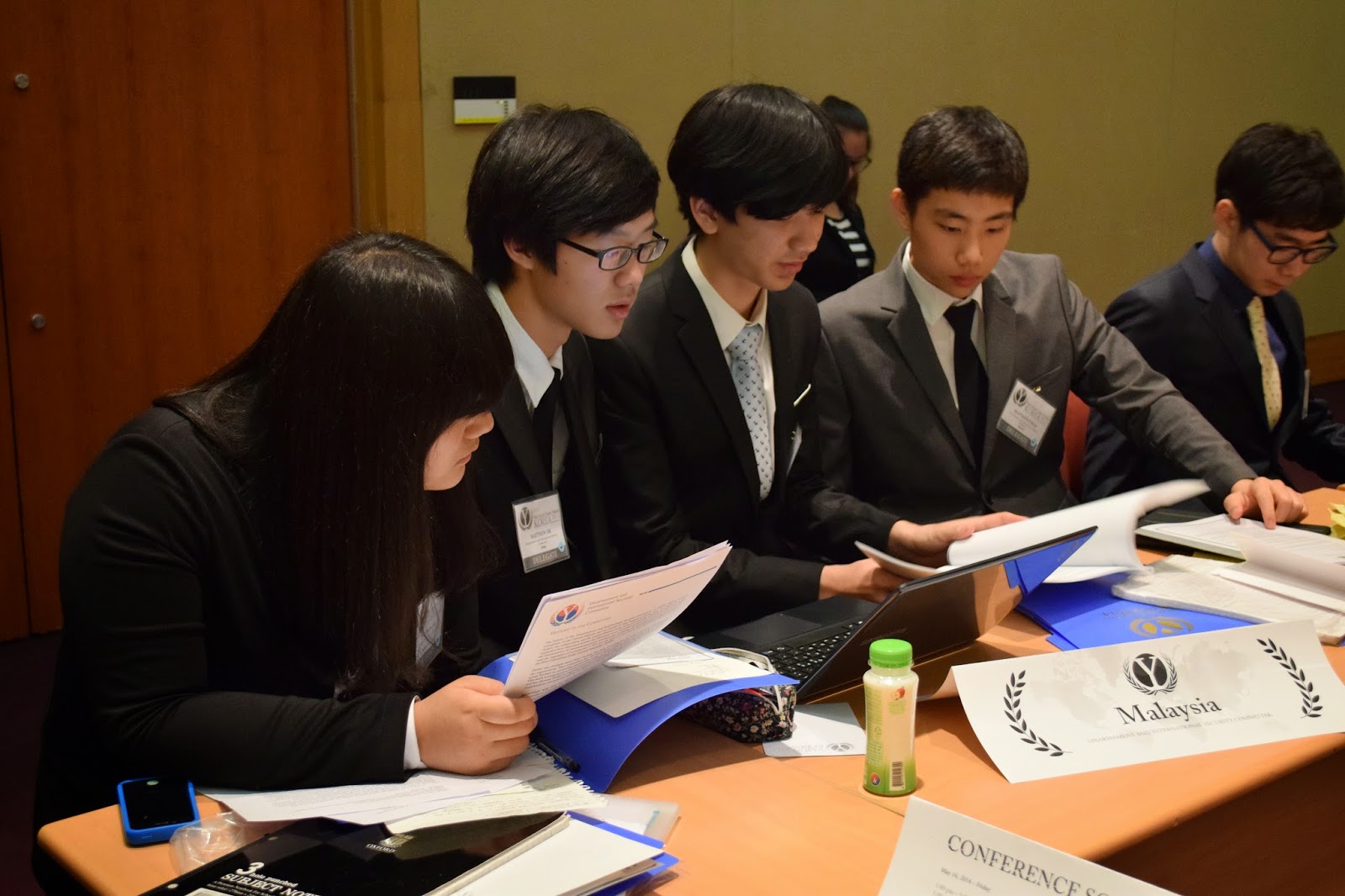
Disarmament and International Security Committee
The first session of DISEC began with a call to order by the chair. The committee then moved on to opening speeches for the first topic, the topic of blood diamonds. Once the opening speeches were finished, the house broke into unmoderated caucus, and delegates of similar interests grouped together and began discussion possible solutions to the issue of blood diamonds at hand.
The first session of DISEC began with a call to order by the chair. The committee then moved on to opening speeches for the first topic, the topic of blood diamonds. Once the opening speeches were finished, the house broke into unmoderated caucus, and delegates of similar interests grouped together and began discussion possible solutions to the issue of blood diamonds at hand.
The room was filled with sounds of delegates earnestly putting forth their ideas, and working together to come up with clauses. For the delegate of Pakistan, this YMUN is her second conference, and she said that the environment seemed friendly and that the “delegates seem familiar with each other.” She and her small team have come up with rather radical measures to address the issue of blood diamonds. Laughingly, she admitted that the measures will “get a lot of rebuttals”, but she still seemed intent on including the clause. The delegate of Australia also had a similar viewpoint about the lobbying session so far, stating that it was “going quite well.” He and four other delegates were writing clauses focused on the aspects of expanding the definition of the term “blood diamond” and raising awareness in the general public as ways to solve the issue. Despite the fact that it is his first conference, he seemed to be relatively at ease when working with others to create the best clauses possible.
The debate in DISEC will be a clause-by-clause debate, with delegates producing and submitting clauses instead of whole resolutions. The approved clauses will then be added to the master resolution for each topic, resulting in a total of two resolutions for the two topics. When asked what would happen if the resolution were to fail, Vice-Chair Walter Yeo replied, “We have no plan if it does, but I hope that won’t happen” with a nervous laugh. Hopefully the resolution will pass, or the conference would have been fruitless!
by Yoonjie Park
by Yoonjie Park
Economic and Financial Committee
Delegates started forming blocs early in ECOFIN, with a Middle Eastern bloc, a European Bloc and a third bloc comprising a motley group of countries.
The first topic of ECOFIN is the ensuring of the Equitable Distribution of Transnational Natural Resources. Most of the lobbying time was spent discussing the issue of water scarcity. With just under an hour of council time left, the chair intervened and advised the delegates to focus specifically on economic solutions that address the problems at hand and to move on to other topics such as fisheries, and oil.
With no clauses being submitted 20 minutes before the council session ended, it seems like ECOFIN needs to up their game and get up to speed in the debate session tomorrow. We look forward to hearing from the delegates then. Stay tuned.
by Linus Seah

by Linus Seah
United Nations Children's Fund
UNICEF began its first session at YMUN Korea 2014 with passionate opening speeches from its delegates. The first agenda on the table was the issue of juvenile incarceration, which continues to haunt social policies and budget plans of countless nations around the world. The suggestions made by delegates in their opening speeches were centered around ensuring the rights of incarcerated juveniles, creating preventive plans for future crimes, and other critical aspects of the issue.
The opening speeches, although deemed by some as an unnecessary procedure, served as a fundamental stage for delegates to propose their ideas and establish the main focus of debate for the subsequent lobbying session. The delegate of South Africa emphasized that crimes committed by the youth are often “forced by the social atmosphere,” such as murders perpetrated by child soldiers in wartime. Delegates of other nations reiterated this important notion as they discussed the setting of an appropriate minimum age for criminal responsibility. The delegate of Turkey presented the idea of using medication as an alternative to traditional methods of detention, while echoing the delegate of South Africa that urbanization often leads to poor education and exposure to crime at a younger age. At the end of the opening speeches, the Chair recapitulated major points put forth by the delegates, such as the importance of proper training of law enforcement officers to reduce in-prison abuse of juvenile offenders, improving data collection of offenders’ statistics, and effectively reintegrating juvenile delinquents back into society.
During the actual lobbying process, it was clear that the delegates were solely concerned with the content of the issues rather than the competition over main-submissions. A lobbying group consisting of about a dozen delegates were debating the specific issue of discriminating offenders by their age. The delegate of Britain suggested a scenario of having a fourteen-year-old who had committed murder and another fourteen-year-old convicted of theft. “When teenagers convicted of different levels of crime are put together, they naturally form a hierarchy within the prison,” the delegate said. “Upon their release these cliques form gangs that place the ones with the most serious crimes at the top of their hierarchy.”
On the other hand, the delegate of Turkey hoped to raise the age at which criminals are tried as adults. In addressing such a concern, the lobbying group compromised by setting the minimum age of adulthood as seventeen and creating separate punitive systems and detention centers for those convicted of more severe acts.
The membership of the UNICEF formed a diverse range, from novice delegates who were becoming accustomed to Model UN to those who actively engaged themselves in the clause-writing process. The Chair and Vice Chair took special care to assist the less experienced delegates who were unable to join the lobbying groups and helped them solidify their ideas into proposals for a clause. All was well in the UNICEF as the first session of the conference came to an end.
by Seoyoon Choi
United Nations Development Programby Seoyoon Choi
The UNDP was well into its lobbying session on the first session of YMUN Korea 2014. Delegates had formed several lobbying groups to discuss major aspects of the issue - improving self-sustainable economies through loans. Although different groups were discussing largely similar aspects of the issue, their approaches to the problem and their proposals for solutions differed. One of the groups discussed the possibility of creating a new organization under the United Nations to ensure transparency of the use of loans, whereas others emphasized establishing guidelines for whether grants or loans would be provided to individuals.
The topic of improving economies through loans is one that is economically and politically complex, especially for high school students. The delegates agreed that the chair report clarified many misunderstandings about the issue, especially regarding the concept of microfinance loans. Microfinance loans refer to loans given out to individuals and small businesses, which conventionally had the problem of high interest rates and failure to effectively improve the plight of “the poorest of the poor.” Individuals with business and other economic initiatives who are temporarily burdened may benefit from these loans; those that are currently unable to provide for themselves with even the most basic necessities like food are unlikely to be helped.
At the end of the session, a number of clauses had been proposed by the delegates, such as one that involved a “territorial loaning program,” devised by the delegate of Brazil, a novice delegate, and her members from her bloc. The delegate of Brazil and others who were rather inexperienced in Model UN commented that despite their initial confusion with the procedures, the Chair and the Vice Chair guided them through the process. The delegate of Australia, a seasoned member of MUN, noted that despite her previous experience with clause-by-clause format in the Security Council, she had found the new YMUN format confusing in the beginning. Despite the confusion faced by some, the delegates of the UNDP, varying in the level of experience and their perspectives on issues, all agreed tonight’s session had truly been an enriching one, and they looked forward to the upcoming debates.
by Seoyoon Choi

United Nations Environment Program
After opening
speeches, delegates had the opportunity to lobby for the rest of the session.
Throughout this unmoderated caucus, it was observed that delegates were divided
into two different blocs. The first bloc believed that developing countries
should invest in green technology to reduce emissions of greenhouse gases, as they
are the main contributors of pollution. The second bloc suggested making an
international fund that would distribute financial aid to help developing countries
control and manage pollution.
During the lobbying
section, I had a chance to interview the Chair and Vice-Chair and ask about
their expectations for the conference from the delegates. Angie Hanawa, the
Chair said, “This issue is very complex, they deal very much with natural
consequences that humans have very little control over. No one wants
transnational pollution. If it were up to people, they would just contain it in
their own countries. So, I’m very much looking forward to see how they will
deal with the human’s inability to control nature and the kinds of solutions
the delegates will come up with.” Next, I interviewed the Vice-Chair, HyukJoon
Kwon. He said he loved the passion the delegates have shown so far. Describing his
expectations for the conference, HyukJoon said, “I hope the delegates will try
to be constructive and not destructive, in MUN, delegates tend to fight with
each other but I hope they try to work as one whole.” Hopefully, the UNEP would
be able to conduct a meaningful and fruitful debate for the rest of the
conference!
by Jenny Park
by Jenny Park
United Nations Human Rights Council
When I walked into the
UNHRC committee room, delegates were already split into groups writing clauses.
The majority of the delegates here were first-timers, and they were very
generous with their ideas; all of the delegates utilized Google-docs to
merge their clauses together.
The chair of this
committee, Houriiya Tegally, briefly explained that the opening speeches were
to be kept in between 45-60 seconds each. After hearing other's positions,
delegates separated into groups with people who had similar ideas or agreeable
terms. After groups were formed, the delegations worked together to write
clauses to sub-topics.
Today’s session
focused on Topic 1 - Women Rights in Post-conflict Nations. Most
delegates focused their ideas on empowering women through education. In
her efforts to see a diverse and comprehensive resolution passed, the chair
encouraged the delegates to take different approaches to the issue. The
committee will continue its work by debating the clauses that were submitted
after today’s session.
by Zoey Ryu

United Nations Security Council
After roll call, the UNSC session began with a brief introduction of the chairs. Interestingly, the Advisory Panel On Cyber-Security was amalgamated with the United Nations Security Council, and hence there are four chairs in this committee: Nagyon Kim, Daniel Silverman, Leo Espinoza and David Steiner.
After giving opening speeches, the delegates broke into an unmoderated caucus to come up with clauses to debate for the rest of the session. By working together, delegates will come up with one resolution for each topic.
Nagyon Kim, a chair from Seoul International School, expressed his excitement on chairing for the first time. He said, “ I hope to see a fruitful debate over the next two days.” While Nagyon was speaking, Leo Espinoza constantly encouraged delegates to quickly write clauses for approval by the chairs. The delegates responded in kind – many of them rushed to write out clauses and were frantically running around the room looking for signatories. Despite all the rush, most delegates seemed to enjoy interacting with one another.
Many delegates in the UNSC are experienced delegates, which might explain why the committee session ran very smoothly as the delegates had no problem formulating clauses and exchanging ideas. Tomorrow, they will debate on the clauses they came up with after concluding their lobbying today.
by Zoey Ryu
World Health Organization
WHO’s first committee
session opened tonight with a series of rousing speeches by the delegates. The
topic at hand was the full eradication of polio, especially in light of the
instability in Afghanistan, Pakistan, Nigeria and Syria.
During their opening speeches, many
delegates declared their dedication to helping affected countries resolve these
issues. “Peru
is willing to provide viable solutions not only for Peru, but for the stability
and prosperity of the entire world,” pledged the delegate of Peru. Israel also
commented, “This whole issue is not a local one. Fellow nations need to join
hands to end this injustice.”
Many delegates identified the root
problems at hand. The delegate of Germany urged for nations to prioritize
diplomatic relations and for the gaining of presidential support in relevant
countries, the delegate of Pakistan recognized the problems of human rights
exploitation behind these issues and the delegate of USA emphasized the need
for reform in order to put a stop to these problems.
After the opening speeches, the
chairperson of the WHO committee, Mr Joao Pedro
Drechsler,
explained the procedures of lobbying that would take place next. The delegates
had the opportunity to move around and gather with like-minded delegates to
propose clauses that would eventually be part of the resolution passed by the
entire committee.
During the lobbying, most delegates were
able to come to a consensus on the lack of consent and willingness for polio
vaccinations as the problem hindering its full eradication. They also
identified anti-Western sentiments and religious beliefs in polio-prone areas
as reasons for this lack of consent. These reasons, along with the threat of
war in polio-prone areas such as Afghanistan, Pakistan, Nigeria and Syria,
contribute greatly to the lack of safety in sending medical officers into these
areas to provide vaccinations.
With these in mind, the delegates entered
a heated discussion that resulted in the submission of six clauses by the end
of this first session, among them being one submitted by the Russian
Federation, which requested for vaccinations and knowledge of how to administer
them to be distributed to local Non-Governmental Organisations (NGOs), who
would then distribute them to locals.
Although a number of clauses were submitted,
there were not many that targeted specifically the situation in war-torn
regions. During the next session, the delegates will be debating these clauses
and editing them to form a final resolution on polio eradication. When asked
about his sentiments on tonight’s first session, the Chairperson Mr Drechsler said, “The committee
session was a little bit slow, but it soon picked up pace. The delegates
submitted a grand total of 6 clauses that are very strong, and we’re still
going to receive a couple more clauses by tomorrow morning. So I’m excited
about what is going to come out of the conference.”
by Gan Sylvia
by Gan Sylvia
Subscribe to:
Posts
(
Atom
)


