
Showing posts with label UNDP. Show all posts
For Your Information: Prevention of Misappropriation of Humanitarian Aid (UNDP Topic B)

Humanitarian aid
provides essential post-natural disaster relief. However, corruption is a huge
problem in humanitarian aid as it often flows through unmonitored channels. Consequently,
it is hard to ensure that the aid given reaches its target audience as it is
hard to trace and track the handling of this aid in the midst of a national
crisis such as a natural disaster. For example, the aid could be stolen and
sent to the black market.
In recent years,
the humanitarian aid being sent to Uganda has been greatly misemployed. In
October 2012, aid from several countries in Europe have been transported to the
unauthorized charges of Ugandan Prime Minister Anama Mbabazi, leading to a
scandal that involved Uganda having to return all the monetary aid that it was
initially conferred. Uganda has consistently distributed its aid unequally even
though more than half of Uganda’s budget is funded through foreign humanitarian
aids. Civil war has continued endlessly for the past 2 decades between the
government and Lord’s Resistance Army (LRA) and over two million people have
been driven out and forced to live in terrible conditions. A majority of the
aid is being distributed unfairly according to regional differences. It is
apparent that Uganda has not learnt its lesson and continues to be one of the
most corrupt countries.
One of the most
severe natural disasters in history, Typhoon Haiyan, struck the Philippines and
wrecked havoc in the country, leaving it in need of much aid from the global
community. The recovery is predicted to be a long and slow one and there are
already concerns of corruption with regards to the humanitarian aid that she is
receiving. The donor organizations and the recipient country have to ensure
that the aid is not misused and that it reaches to those in need directly.
Misappropriation
in humanitarian aid is not an issue that will be solved overnight. Yet, we must
take small steps to solve the problem. Agencies have a set of common policies
that they implement to stem the risk of corruption. This system is called the
whistle blowing mechanism and is intended to allow a staff to communicate
confidentially with officials outside the immediate situation, to report
corrupt activities. However, the problem is that the staff is not familiar with
the processes involved and thus do not use it effectively and widely.
It is essential
to spread the policies controlling corruption to prevent it from happening. Simply
sending aid to needy countries during emergencies will not solve the problems
of corruption. Management of recipient countries also needs to be taken care
of. Agencies are also considering poor management as a problem and many have
put in human source managers in order to facilitate the flow of humanitarian
aid towards its target destination. Finally, improved monitoring and
accountability mechanisms are essential in the battle against corruption. Even though these measures do not cease
corruption immediately, it does slowly but surely tackle the problem at hand.
by Jenny Park
Photo courtesy of https://haitiquake-archive.unlb.org/Picture%20Library/Forms/DispForm.aspx?ID=526
Committee Session I
After the Opening Ceremony, the nine committees got right into action in their first committee session. Here's our Press Corps' coverage of Committee Session I:
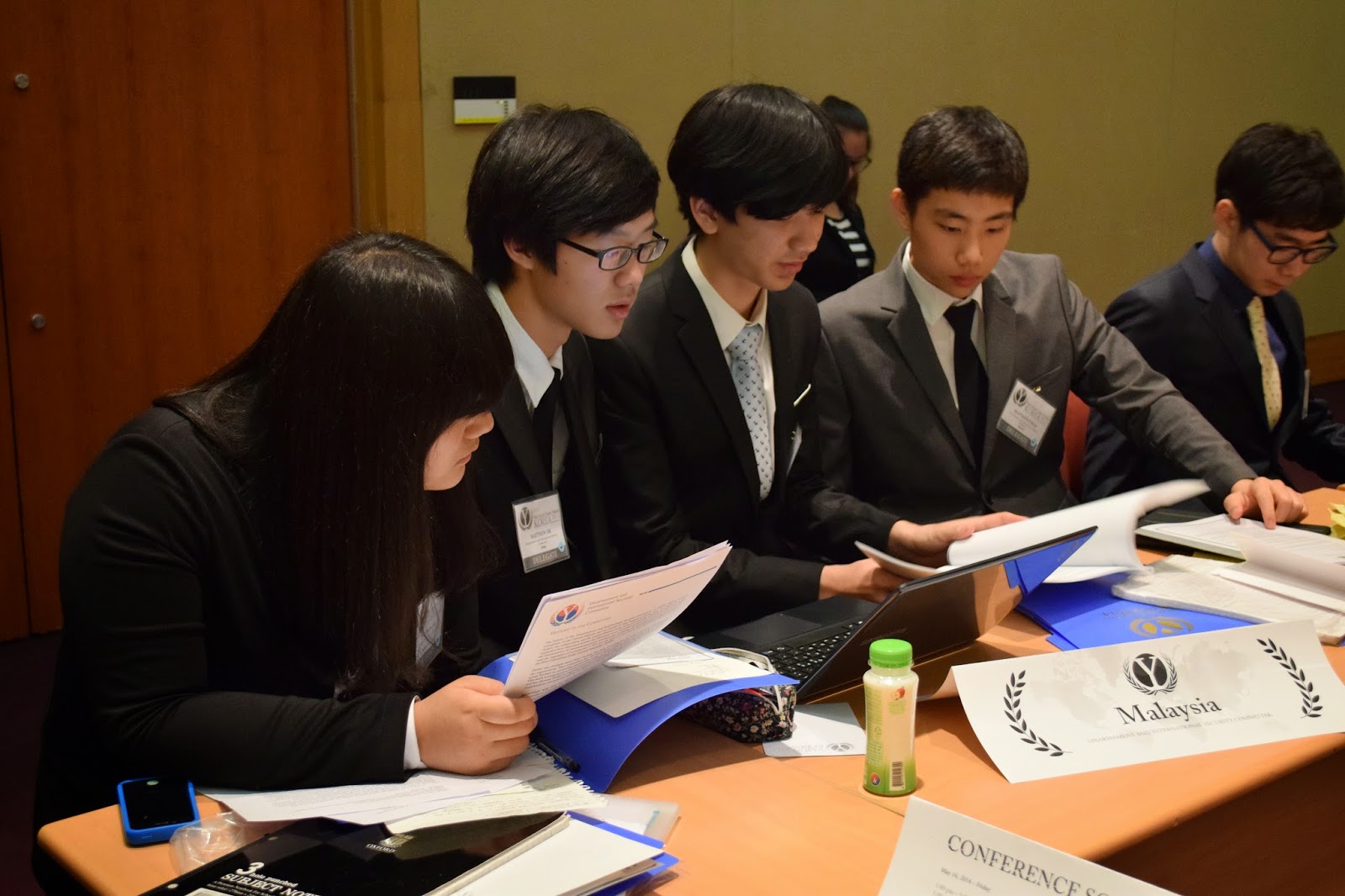
Disarmament and International Security Committee
The first session of DISEC began with a call to order by the chair. The committee then moved on to opening speeches for the first topic, the topic of blood diamonds. Once the opening speeches were finished, the house broke into unmoderated caucus, and delegates of similar interests grouped together and began discussion possible solutions to the issue of blood diamonds at hand.
The first session of DISEC began with a call to order by the chair. The committee then moved on to opening speeches for the first topic, the topic of blood diamonds. Once the opening speeches were finished, the house broke into unmoderated caucus, and delegates of similar interests grouped together and began discussion possible solutions to the issue of blood diamonds at hand.
The room was filled with sounds of delegates earnestly putting forth their ideas, and working together to come up with clauses. For the delegate of Pakistan, this YMUN is her second conference, and she said that the environment seemed friendly and that the “delegates seem familiar with each other.” She and her small team have come up with rather radical measures to address the issue of blood diamonds. Laughingly, she admitted that the measures will “get a lot of rebuttals”, but she still seemed intent on including the clause. The delegate of Australia also had a similar viewpoint about the lobbying session so far, stating that it was “going quite well.” He and four other delegates were writing clauses focused on the aspects of expanding the definition of the term “blood diamond” and raising awareness in the general public as ways to solve the issue. Despite the fact that it is his first conference, he seemed to be relatively at ease when working with others to create the best clauses possible.
The debate in DISEC will be a clause-by-clause debate, with delegates producing and submitting clauses instead of whole resolutions. The approved clauses will then be added to the master resolution for each topic, resulting in a total of two resolutions for the two topics. When asked what would happen if the resolution were to fail, Vice-Chair Walter Yeo replied, “We have no plan if it does, but I hope that won’t happen” with a nervous laugh. Hopefully the resolution will pass, or the conference would have been fruitless!
by Yoonjie Park
by Yoonjie Park
Economic and Financial Committee
Delegates started forming blocs early in ECOFIN, with a Middle Eastern bloc, a European Bloc and a third bloc comprising a motley group of countries.
The first topic of ECOFIN is the ensuring of the Equitable Distribution of Transnational Natural Resources. Most of the lobbying time was spent discussing the issue of water scarcity. With just under an hour of council time left, the chair intervened and advised the delegates to focus specifically on economic solutions that address the problems at hand and to move on to other topics such as fisheries, and oil.
With no clauses being submitted 20 minutes before the council session ended, it seems like ECOFIN needs to up their game and get up to speed in the debate session tomorrow. We look forward to hearing from the delegates then. Stay tuned.
by Linus Seah

by Linus Seah
United Nations Children's Fund
UNICEF began its first session at YMUN Korea 2014 with passionate opening speeches from its delegates. The first agenda on the table was the issue of juvenile incarceration, which continues to haunt social policies and budget plans of countless nations around the world. The suggestions made by delegates in their opening speeches were centered around ensuring the rights of incarcerated juveniles, creating preventive plans for future crimes, and other critical aspects of the issue.
The opening speeches, although deemed by some as an unnecessary procedure, served as a fundamental stage for delegates to propose their ideas and establish the main focus of debate for the subsequent lobbying session. The delegate of South Africa emphasized that crimes committed by the youth are often “forced by the social atmosphere,” such as murders perpetrated by child soldiers in wartime. Delegates of other nations reiterated this important notion as they discussed the setting of an appropriate minimum age for criminal responsibility. The delegate of Turkey presented the idea of using medication as an alternative to traditional methods of detention, while echoing the delegate of South Africa that urbanization often leads to poor education and exposure to crime at a younger age. At the end of the opening speeches, the Chair recapitulated major points put forth by the delegates, such as the importance of proper training of law enforcement officers to reduce in-prison abuse of juvenile offenders, improving data collection of offenders’ statistics, and effectively reintegrating juvenile delinquents back into society.
During the actual lobbying process, it was clear that the delegates were solely concerned with the content of the issues rather than the competition over main-submissions. A lobbying group consisting of about a dozen delegates were debating the specific issue of discriminating offenders by their age. The delegate of Britain suggested a scenario of having a fourteen-year-old who had committed murder and another fourteen-year-old convicted of theft. “When teenagers convicted of different levels of crime are put together, they naturally form a hierarchy within the prison,” the delegate said. “Upon their release these cliques form gangs that place the ones with the most serious crimes at the top of their hierarchy.”
On the other hand, the delegate of Turkey hoped to raise the age at which criminals are tried as adults. In addressing such a concern, the lobbying group compromised by setting the minimum age of adulthood as seventeen and creating separate punitive systems and detention centers for those convicted of more severe acts.
The membership of the UNICEF formed a diverse range, from novice delegates who were becoming accustomed to Model UN to those who actively engaged themselves in the clause-writing process. The Chair and Vice Chair took special care to assist the less experienced delegates who were unable to join the lobbying groups and helped them solidify their ideas into proposals for a clause. All was well in the UNICEF as the first session of the conference came to an end.
by Seoyoon Choi
United Nations Development Programby Seoyoon Choi
The UNDP was well into its lobbying session on the first session of YMUN Korea 2014. Delegates had formed several lobbying groups to discuss major aspects of the issue - improving self-sustainable economies through loans. Although different groups were discussing largely similar aspects of the issue, their approaches to the problem and their proposals for solutions differed. One of the groups discussed the possibility of creating a new organization under the United Nations to ensure transparency of the use of loans, whereas others emphasized establishing guidelines for whether grants or loans would be provided to individuals.
The topic of improving economies through loans is one that is economically and politically complex, especially for high school students. The delegates agreed that the chair report clarified many misunderstandings about the issue, especially regarding the concept of microfinance loans. Microfinance loans refer to loans given out to individuals and small businesses, which conventionally had the problem of high interest rates and failure to effectively improve the plight of “the poorest of the poor.” Individuals with business and other economic initiatives who are temporarily burdened may benefit from these loans; those that are currently unable to provide for themselves with even the most basic necessities like food are unlikely to be helped.
At the end of the session, a number of clauses had been proposed by the delegates, such as one that involved a “territorial loaning program,” devised by the delegate of Brazil, a novice delegate, and her members from her bloc. The delegate of Brazil and others who were rather inexperienced in Model UN commented that despite their initial confusion with the procedures, the Chair and the Vice Chair guided them through the process. The delegate of Australia, a seasoned member of MUN, noted that despite her previous experience with clause-by-clause format in the Security Council, she had found the new YMUN format confusing in the beginning. Despite the confusion faced by some, the delegates of the UNDP, varying in the level of experience and their perspectives on issues, all agreed tonight’s session had truly been an enriching one, and they looked forward to the upcoming debates.
by Seoyoon Choi

United Nations Environment Program
After opening
speeches, delegates had the opportunity to lobby for the rest of the session.
Throughout this unmoderated caucus, it was observed that delegates were divided
into two different blocs. The first bloc believed that developing countries
should invest in green technology to reduce emissions of greenhouse gases, as they
are the main contributors of pollution. The second bloc suggested making an
international fund that would distribute financial aid to help developing countries
control and manage pollution.
During the lobbying
section, I had a chance to interview the Chair and Vice-Chair and ask about
their expectations for the conference from the delegates. Angie Hanawa, the
Chair said, “This issue is very complex, they deal very much with natural
consequences that humans have very little control over. No one wants
transnational pollution. If it were up to people, they would just contain it in
their own countries. So, I’m very much looking forward to see how they will
deal with the human’s inability to control nature and the kinds of solutions
the delegates will come up with.” Next, I interviewed the Vice-Chair, HyukJoon
Kwon. He said he loved the passion the delegates have shown so far. Describing his
expectations for the conference, HyukJoon said, “I hope the delegates will try
to be constructive and not destructive, in MUN, delegates tend to fight with
each other but I hope they try to work as one whole.” Hopefully, the UNEP would
be able to conduct a meaningful and fruitful debate for the rest of the
conference!
by Jenny Park
by Jenny Park
United Nations Human Rights Council
When I walked into the
UNHRC committee room, delegates were already split into groups writing clauses.
The majority of the delegates here were first-timers, and they were very
generous with their ideas; all of the delegates utilized Google-docs to
merge their clauses together.
The chair of this
committee, Houriiya Tegally, briefly explained that the opening speeches were
to be kept in between 45-60 seconds each. After hearing other's positions,
delegates separated into groups with people who had similar ideas or agreeable
terms. After groups were formed, the delegations worked together to write
clauses to sub-topics.
Today’s session
focused on Topic 1 - Women Rights in Post-conflict Nations. Most
delegates focused their ideas on empowering women through education. In
her efforts to see a diverse and comprehensive resolution passed, the chair
encouraged the delegates to take different approaches to the issue. The
committee will continue its work by debating the clauses that were submitted
after today’s session.
by Zoey Ryu

United Nations Security Council
After roll call, the UNSC session began with a brief introduction of the chairs. Interestingly, the Advisory Panel On Cyber-Security was amalgamated with the United Nations Security Council, and hence there are four chairs in this committee: Nagyon Kim, Daniel Silverman, Leo Espinoza and David Steiner.
After giving opening speeches, the delegates broke into an unmoderated caucus to come up with clauses to debate for the rest of the session. By working together, delegates will come up with one resolution for each topic.
Nagyon Kim, a chair from Seoul International School, expressed his excitement on chairing for the first time. He said, “ I hope to see a fruitful debate over the next two days.” While Nagyon was speaking, Leo Espinoza constantly encouraged delegates to quickly write clauses for approval by the chairs. The delegates responded in kind – many of them rushed to write out clauses and were frantically running around the room looking for signatories. Despite all the rush, most delegates seemed to enjoy interacting with one another.
Many delegates in the UNSC are experienced delegates, which might explain why the committee session ran very smoothly as the delegates had no problem formulating clauses and exchanging ideas. Tomorrow, they will debate on the clauses they came up with after concluding their lobbying today.
by Zoey Ryu
World Health Organization
WHO’s first committee
session opened tonight with a series of rousing speeches by the delegates. The
topic at hand was the full eradication of polio, especially in light of the
instability in Afghanistan, Pakistan, Nigeria and Syria.
During their opening speeches, many
delegates declared their dedication to helping affected countries resolve these
issues. “Peru
is willing to provide viable solutions not only for Peru, but for the stability
and prosperity of the entire world,” pledged the delegate of Peru. Israel also
commented, “This whole issue is not a local one. Fellow nations need to join
hands to end this injustice.”
Many delegates identified the root
problems at hand. The delegate of Germany urged for nations to prioritize
diplomatic relations and for the gaining of presidential support in relevant
countries, the delegate of Pakistan recognized the problems of human rights
exploitation behind these issues and the delegate of USA emphasized the need
for reform in order to put a stop to these problems.
After the opening speeches, the
chairperson of the WHO committee, Mr Joao Pedro
Drechsler,
explained the procedures of lobbying that would take place next. The delegates
had the opportunity to move around and gather with like-minded delegates to
propose clauses that would eventually be part of the resolution passed by the
entire committee.
During the lobbying, most delegates were
able to come to a consensus on the lack of consent and willingness for polio
vaccinations as the problem hindering its full eradication. They also
identified anti-Western sentiments and religious beliefs in polio-prone areas
as reasons for this lack of consent. These reasons, along with the threat of
war in polio-prone areas such as Afghanistan, Pakistan, Nigeria and Syria,
contribute greatly to the lack of safety in sending medical officers into these
areas to provide vaccinations.
With these in mind, the delegates entered
a heated discussion that resulted in the submission of six clauses by the end
of this first session, among them being one submitted by the Russian
Federation, which requested for vaccinations and knowledge of how to administer
them to be distributed to local Non-Governmental Organisations (NGOs), who
would then distribute them to locals.
Although a number of clauses were submitted,
there were not many that targeted specifically the situation in war-torn
regions. During the next session, the delegates will be debating these clauses
and editing them to form a final resolution on polio eradication. When asked
about his sentiments on tonight’s first session, the Chairperson Mr Drechsler said, “The committee
session was a little bit slow, but it soon picked up pace. The delegates
submitted a grand total of 6 clauses that are very strong, and we’re still
going to receive a couple more clauses by tomorrow morning. So I’m excited
about what is going to come out of the conference.”
by Gan Sylvia
by Gan Sylvia
For Your Information: Improving Self-Sustainable Economies through Loans (UNDP Topic A)
Here's an article on UNDP's Topic A: Improving Self-Sustainable Economies through Loans

Meet the UNDP Chair
Bios
,
Chair
,
UNDP
,
Yale Secretariat

Joyce Xi was born in Maryland and has lived most of her life in Pennsylvania. She is from State College, Pennsylvania and currently a junior in Ezra Stiles College at Yale University, where she is studying chemistry and economics. Joyce’s hobbies include photography, piano, traveling, eating and meeting new people on her trips. Her favorite place so far is Nepal, which is home to eight of the world’s ten tallest mountains in the world, including Mt. Everest.
Joyce
is the UNDP (United Nations Development Programme) chair and the USG (Under
Secretary General) of Marketing) for YMUN Korea 2014. As part of the job scope,
Joyce has been working on securing sponsorships, keeping the YMUN Korea
Facebook page active, writing topic guides for her committee, and of course,
reading up on fun and interesting things to do in Seoul. A member of Yale
International Relations Association (YIRA), Joyce has experience working as a
staff at YMUN earlier this year. “It was a great learning experience for me
that has helped me prepare for this conference!” she shared.
Joyce
was first motivated to become the UNDP chair this year because she has
experience with the committee and loved the topics. She said, “I love working
with younger students and hearing their perspectives. I also love the topics of
my committee, UNDP, and am very interested in development economics.” Joyce’s
favorite thing about MUN? “It is meeting the people involved and making great
friends, as well as hearing the diverse viewpoints every delegate brings to the
discussion,” Joyce shared.
YMUN
Korea 2014 would be Joyce’s first time chairing at a MUN. For her, the most
difficult part of being a chair is keeping track of all the rules and trying to
ensure that the delegates have a fruitful experience. While being this
experience might seem daunting, Joyce is looking forward to the experience. She
said, “I am fortunate to have this chance to chair a MUN conference for the
first time – I look forward to leading my favorite committee, UNDP!”
Joyce’s
advice to delegates attending YMUN Korea? “Stay engaged during the entirety of
committee and listen carefully to what your peers have to say. That will give
you the opportunity to work better together when you need to collaborate.” She
added, “MUNs are a great learning experience for everyone. I can’t wait to meet
all my delegates to get to know them and hear their ideas!”
by Jenny Park
by Jenny Park
Subscribe to:
Posts
(
Atom
)


